- HR
- Management
Modern HR Management: Automating the Employee Lifecycle From Hire to Retire
HR teams spend up to 40% of their time on administrative tasks. Discover how modern HR management systems automate recruitment, onboarding, payroll, and performance management — freeing your team to focus on people strategy.
The Administrative Burden on HR
Human Resources professionals entered the field to work with people — not paperwork. Yet the reality for most HR teams is starkly different:
- 40% of HR time is spent on administrative tasks (PwC)
- Manual payroll processing takes 5+ hours per pay period for mid-sized companies
- Paper-based onboarding creates inconsistent experiences and missing documentation
- Spreadsheet-based time tracking leads to errors and compliance risks
- Annual performance reviews are dreaded by managers and employees alike
The result: HR teams are reactive rather than strategic, constantly putting out fires instead of building the culture and talent pipeline that drives business success.
The Employee Lifecycle, Automated
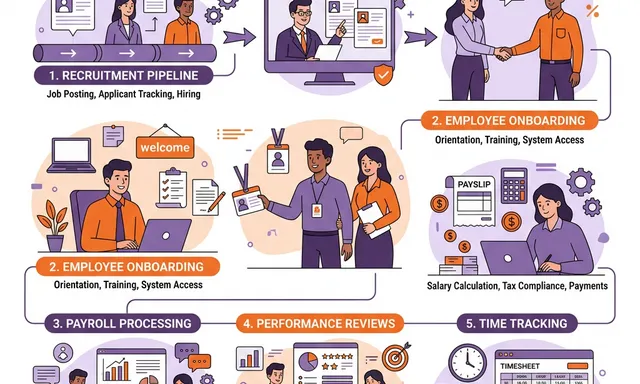
Modern HR management systems (HRMS) transform every stage of the employee lifecycle:
1. Recruitment & Hiring
From job posting to offer letter — streamlined:
- Multi-channel job posting — publish to job boards, social media, and your careers page from one click
- Applicant tracking — manage candidates through customizable hiring stages (Applied → Screening → Interview → Offer → Hired)
- Resume parsing — automatically extract candidate information from CVs
- Interview scheduling — coordinate availability across hiring committee members
- Offer management — generate, send, and e-sign offer letters within the system
- Hiring analytics — track time-to-hire, cost-per-hire, and source effectiveness
2. Onboarding
Make day one (and the first 90 days) exceptional:
- Automated onboarding checklists tailored by role and department
- Digital document collection — tax forms, ID verification, and policy acknowledgments completed before day one
- Welcome packages with company information, team introductions, and first-week schedules
- IT provisioning integration — automatically trigger account creation, equipment ordering, and access permissions
- Buddy assignment — match new hires with experienced team members
- 30/60/90-day check-in reminders for managers
3. Time & Attendance Management
Accurate, compliant, and effortless:
- Digital time tracking via web, mobile, or biometric terminals
- Flexible scheduling with shift patterns, rotations, and overtime rules
- Leave management — request, approve, and track PTO, sick leave, and other absences
- Calendar integration — sync with Outlook, Google Calendar, and project management tools
- Compliance automation — enforce break requirements, maximum hours, and overtime calculations
4. Payroll Processing
The most error-sensitive HR function, automated:
- Automated calculations — salary, hourly, overtime, commissions, and deductions
- Tax withholding — federal, state, and local tax calculations updated automatically
- Benefits deductions — health insurance, retirement contributions, and other benefits
- Multi-country support — process payroll for employees in different jurisdictions
- Pay stub generation — employees access digital pay stubs through self-service portal
- Direct deposit integration — payments processed automatically on schedule
5. Performance Management
Move beyond the annual review:
- Continuous feedback — real-time recognition and coaching conversations
- Goal setting and tracking — OKRs or KPIs aligned with organizational objectives
- 360-degree feedback — input from managers, peers, direct reports, and self
- Performance calibration — ensure consistent rating standards across departments
- Skill gap analysis — identify development needs and create training plans
- Succession planning — identify and develop future leaders
6. Expense Management
Eliminate the expense report nightmare:
- Mobile receipt capture — photograph receipts and auto-extract vendor, amount, and date
- Policy enforcement — automatic validation against spending policies
- Approval workflows — route to appropriate managers based on amount and category
- Integration with accounting — approved expenses post directly to the general ledger
- Mileage tracking — GPS-based mileage calculation for travel reimbursement
Employee Self-Service: The Game Changer
Modern HRMS platforms empower employees to manage their own information:
- Personal information updates — address, emergency contacts, banking details
- Leave requests and balances — request time off and see remaining balances
- Pay stubs and tax documents — access W-2s, pay stubs, and benefit statements
- Training enrollment — browse and register for available courses
- Company directory — find colleagues by name, department, or skill
Impact: Employee self-service reduces HR inquiry volume by 40–60%, freeing the HR team for strategic work.
HR Analytics That Drive Decisions
Transform HR from a cost center to a strategic partner:
| Metric | What It Reveals | Action Trigger |
|---|---|---|
| Turnover rate by department | Management or culture issues | > 15% annual turnover |
| Time-to-fill | Recruiting efficiency | > 45 days average |
| Training completion rate | L&D program effectiveness | < 80% completion |
| Absence rate | Employee engagement/health | > 4% of workdays |
| Cost per hire | Recruiting efficiency | Trending upward |
| Employee satisfaction (eNPS) | Overall employee experience | < 30 score |
Compliance & Record-Keeping
HR is one of the most regulated business functions. Modern HRMS helps you stay compliant:
- Document retention — automatic management of legally required records
- Audit trails — complete history of every HR action and approval
- Policy acknowledgment tracking — ensure every employee has reviewed current policies
- Equal opportunity reporting — generate EEO-1 and other compliance reports
- Labor law compliance — enforce jurisdiction-specific rules for overtime, breaks, and leave
Why Odoo HR?
Odoo’s HR module provides a complete employee lifecycle solution:
- Recruitment with applicant tracking and evaluation templates
- Employees with org charts, department management, and skills tracking
- Time Off with configurable leave types and allocation rules
- Attendance with check-in/check-out and overtime calculations
- Payroll with multi-country support and automatic calculations
- Expenses with mobile capture and multi-level approval workflows
- Appraisal with customizable evaluation templates and 360-degree feedback
All integrated with a unified business platform — no separate HR silos.
Stay Informed with Expert Insights
Discover the latest trends in ERP, AI, and digital transformation from our certified technology experts.
100+


Resources to boost
your growth