- Manufacturing
- ERP
ERP for Manufacturing: How Smart Factories Use Technology to Outperform
Modern manufacturing demands precision, speed, and visibility that spreadsheets and legacy systems simply cannot deliver. Learn how ERP technology powers the smart factories that are outperforming their competitors.
The Manufacturing Challenge
Manufacturing has never been more complex. Global supply chains, fluctuating raw material costs, labor shortages, quality requirements, and customer expectations for faster delivery — all demand a level of operational precision that manual processes can’t sustain.
Yet many manufacturers still operate with:
- Disconnected systems for production, inventory, purchasing, and finance
- Paper-based processes for work orders, quality checks, and shipping
- Spreadsheet scheduling that can’t handle real-world complexity
- Reactive maintenance that leads to costly unplanned downtime
- Limited visibility into true production costs and margins
The result: 15–25% of manufacturing capacity is wasted on inefficiencies, rework, and downtime.
What Manufacturing ERP Solves
Production Planning & Scheduling
Transform production from art to science:
- Master Production Schedule (MPS) — capacity-aligned production plans based on demand forecasts and orders
- Material Requirements Planning (MRP) — automatic calculation of raw material needs based on production schedules, bills of materials, and current inventory
- Work order management — digital work orders with routing, instructions, and time tracking
- Capacity planning — match production schedules to available machine and labor capacity
- What-if scenarios — model the impact of new orders, machine breakdowns, or supplier delays
Bill of Materials (BOM) Management
Manage product complexity with structured BOMs:
- Multi-level BOMs for complex products with sub-assemblies
- BOM variants for products with configurable options
- By-product and waste tracking for process industries
- Engineering change management with version control and effectivity dates
- Cost roll-up — automatic calculation of standard cost from component costs, labor, and overhead
Quality Control
Build quality into every step:
- Quality control points at receiving, in-process, and final inspection
- Statistical Process Control (SPC) with real-time charting
- Non-conformance tracking with root cause analysis workflow
- Corrective and Preventive Action (CAPA) management
- Certificate of Analysis (CoA) generation for regulated industries
Shop Floor Data Collection
Replace paper-based tracking with real-time digital data:
- Barcode scanning at each production step
- IoT sensor integration for temperature, pressure, and speed monitoring
- Operator time tracking with clock-in/clock-out at work centers
- Scrap and waste recording in real-time
- Production dashboards visible on shop floor displays
Industry 4.0: The Smart Factory
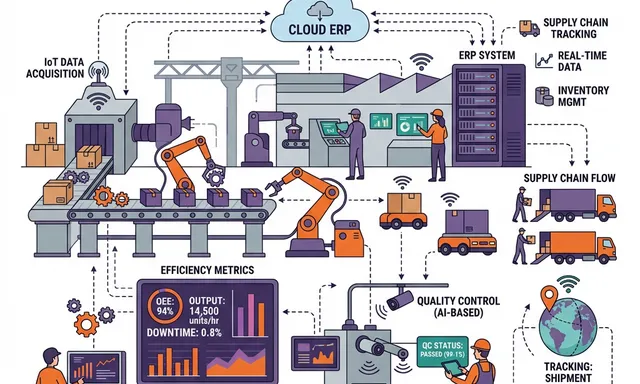
The convergence of ERP, IoT, and AI is creating “smart factories” that operate at unprecedented levels of efficiency:
IoT-Connected Equipment
- Machine sensors feed real-time performance data into ERP
- Overall Equipment Effectiveness (OEE) calculated automatically
- Predictive maintenance alerts before breakdowns occur
- Energy consumption tracking for sustainability reporting
AI-Powered Optimization
- Demand forecasting that accounts for seasonality, promotions, and market trends
- Production scheduling optimization that minimizes changeovers and maximizes throughput
- Quality prediction that identifies defect patterns before they escalate
- Supply chain risk detection that flags potential disruptions early
Digital Twin Simulation
- Virtual factory models that mirror physical production lines
- What-if analysis without risking actual production
- New product introduction simulation to validate processes before launch
- Continuous improvement visualization to quantify the impact of changes
Manufacturing KPIs to Track
| KPI | Target | Why It Matters |
|---|---|---|
| OEE (Overall Equipment Effectiveness) | > 85% | Measures how effectively equipment is used |
| First Pass Yield | > 95% | Quality indicator — % of products right first time |
| On-Time Delivery | > 98% | Customer satisfaction and reliability |
| Inventory Turns | 6–12x/year | Working capital efficiency |
| Scrap Rate | < 2% | Material waste and cost control |
| Planned vs. Actual Production | > 95% | Scheduling accuracy |
| Mean Time Between Failures (MTBF) | Increasing trend | Equipment reliability |
Case Study: Manufacturing Transformation
A mid-sized manufacturer of industrial components was struggling with:
- 23% scrap rate due to quality issues
- 72% on-time delivery rate
- 15-day financial close process
- 4 disconnected systems for production, inventory, sales, and finance
After implementing Odoo ERP with NETLINKS:
- Scrap rate reduced to 4% through real-time quality tracking and SPC
- On-time delivery improved to 96% with automated MRP and production scheduling
- Financial close reduced to 3 days with integrated accounting
- One unified system replaced 4 disconnected tools
ROI: 14-month payback period with $2.1M annual operational savings.
Why Odoo for Manufacturing?
Odoo provides a complete manufacturing suite:
- MRP with multi-level BOM support
- Shop floor management with barcode integration
- Quality module with configurable check points
- Maintenance management for preventive and corrective maintenance
- PLM (Product Lifecycle Management) for engineering change control
- Inventory with lot tracking, serial numbers, and multi-warehouse support
All natively integrated with sales, purchasing, accounting, and HR — eliminating the integration headaches of best-of-breed solutions.
Stay Informed with Expert Insights
Discover the latest trends in ERP, AI, and digital transformation from our certified technology experts.
100+



Resources to boost
your growth