- Inventory
- Operations
Inventory Management Best Practices: Eliminate Stockouts and Reduce Carrying Costs
Poor inventory management costs businesses billions annually through stockouts, excess stock, and inefficient warehouse operations. Learn proven strategies and technologies to optimize your inventory from end to end.
The Trillion-Dollar Inventory Problem
Inventory management might not be glamorous, but it’s where businesses win or lose. Consider the stakes:
- Stockouts cost retailers $1 trillion annually in lost sales (IHL Group)
- Excess inventory ties up working capital and leads to markdowns, spoilage, and write-offs
- Warehouse inefficiency drives up labor costs and slows order fulfillment
- Inaccurate stock data creates ripple effects across sales, purchasing, and finance
For most businesses, inventory is the largest current asset on the balance sheet. Optimizing it isn’t just an operational improvement — it’s a financial transformation.
Core Inventory Management Strategies
1. ABC Classification
Not all inventory items deserve equal attention. ABC analysis segments your stock by value:
- A items (20% of SKUs, 80% of value): Tight controls, frequent counting, demand forecasting
- B items (30% of SKUs, 15% of value): Moderate controls, periodic reviews
- C items (50% of SKUs, 5% of value): Simple controls, bulk ordering, minimal monitoring
This ensures your team focuses energy where it has the greatest financial impact.
2. Just-in-Time (JIT) vs. Safety Stock
JIT philosophy: Minimize inventory by receiving goods only when needed for production or sale. This reduces carrying costs but requires reliable suppliers and accurate demand forecasting.
Safety stock approach: Maintain buffer inventory to protect against supply chain variability. The key is calculating the right amount:
Safety stock = Z × σ × √L
Where:
- Z = service level factor (1.65 for 95% service level)
- σ = standard deviation of demand
- L = lead time in days
The best approach combines both: JIT for predictable items and safety stock for volatile ones.
3. Demand Forecasting
Modern inventory management is predictive, not reactive. Effective forecasting methods include:
- Historical trend analysis — using past sales data to project future demand
- Seasonality modeling — adjusting for known cyclical patterns
- Promotional impact accounting — forecasting demand spikes from marketing campaigns
- External signal integration — incorporating weather, economic indicators, and competitor activity
- Machine learning models — AI that continuously improves prediction accuracy
4. Warehouse Organization
Physical warehouse layout directly impacts picking speed and accuracy:
- Zone picking — organizing by product category or order frequency
- Slotting optimization — placing fastest-moving items closest to shipping
- Cross-docking — routing incoming shipments directly to outbound without storage
- Barcode/RFID scanning — eliminating manual counting and reducing errors to near zero
Technology That Transforms Inventory
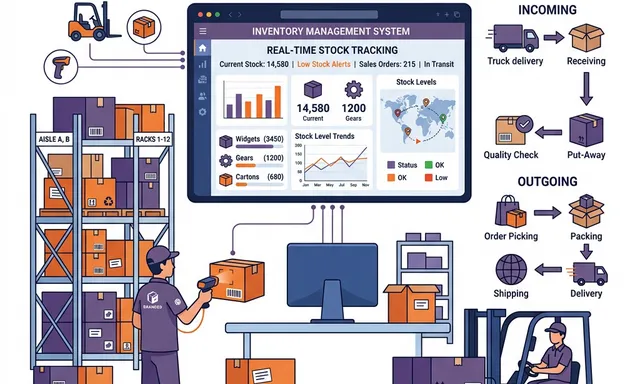
Real-Time Stock Visibility
Modern inventory management systems provide:
- Multi-location tracking — see stock levels across all warehouses, stores, and third-party locations
- Real-time updates — every receive, transfer, and shipment immediately reflected
- Low stock alerts — automated notifications when items approach reorder points
- Lot and serial traceability — track individual items through the entire supply chain
Automated Reordering
Stop relying on manual purchase requests:
- Reorder rules that automatically generate purchase orders when stock hits minimum levels
- Vendor management that selects the optimal supplier based on price, lead time, and reliability
- Three-way matching that validates purchase orders, receipts, and invoices automatically
- Blanket orders for recurring purchases at pre-negotiated prices
Barcode and RFID Integration
Eliminate manual data entry and counting errors:
- Receiving: Scan incoming shipments to instantly update stock and validate against purchase orders
- Picking: Scan-guided picking that routes warehouse staff through the optimal path
- Shipping: Scan outbound packages to confirm accuracy and trigger tracking numbers
- Cycle counting: Regular partial counts that maintain accuracy without full inventory shutdowns
Measuring Inventory Performance
Track these KPIs to ensure continuous improvement:
| KPI | Formula | Best-in-Class Target |
|---|---|---|
| Inventory Turnover | COGS ÷ Average Inventory | Industry-specific (4–12x) |
| Stockout Rate | Stockout events ÷ Total orders | < 2% |
| Carrying Cost % | Carrying costs ÷ Average inventory value | 15–25% |
| Order Accuracy | Correct orders ÷ Total orders | > 99.5% |
| Cycle Count Accuracy | Accurate counts ÷ Total counts | > 98% |
Inventory Management With Odoo
Odoo’s inventory module provides enterprise-grade capabilities without enterprise-grade complexity:
- Multi-warehouse management with inter-warehouse transfers and routes
- Push and pull rules that automatically route products through your supply chain
- Advanced barcode integration with mobile scanning support
- Lot tracking and expiry management for perishable and regulated products
- Real-time valuation using FIFO, standard cost, or average cost methods
- Integrated purchasing — reorder rules automatically create validated purchase orders
And because Odoo is integrated with your sales, manufacturing, and accounting modules, your entire supply chain operates from a single source of truth.
Getting Started
Whether you’re managing inventory in spreadsheets or struggling with an legacy system, NETLINKS Inc. can help you implement modern inventory management that reduces costs and improves customer satisfaction.
Stay Informed with Expert Insights
Discover the latest trends in ERP, AI, and digital transformation from our certified technology experts.
100+



Resources to boost
your growth