- AI
- Automation
Agentic AI and Intelligent Automation: The Future of Business Operations
Agentic AI goes beyond traditional automation — it creates intelligent systems that learn, decide, and optimize independently. Discover how businesses are using AI agents, RPA, and machine learning to transform their operations.
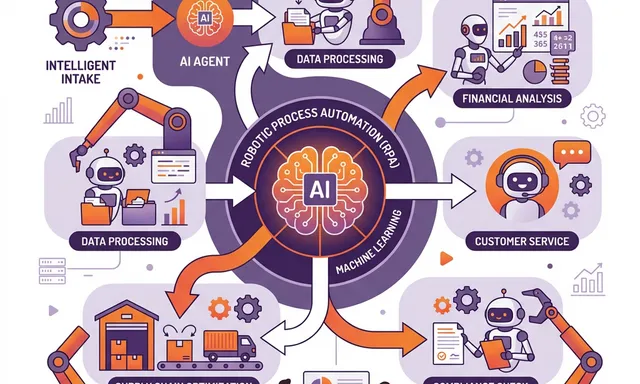
Beyond Traditional Automation
For decades, business automation meant rigid rule-based systems: “If X happens, do Y.” These rules worked well for simple, repetitive tasks — but they couldn’t handle exceptions, learn from outcomes, or adapt to changing conditions.
Agentic AI changes everything.
Agentic AI systems don’t just follow instructions — they perceive their environment, make decisions, take actions, and learn from the results. They’re the difference between a thermostat (follows a rule) and a smart building system (learns occupancy patterns, weather forecasts, and energy prices to optimize comfort and cost simultaneously).
For businesses, this represents the most significant operational leap since the invention of the spreadsheet.
What Is Agentic AI?
Agentic AI refers to AI systems that operate with agency — the ability to:
- Perceive — gather and interpret data from multiple sources
- Reason — analyze situations and consider multiple courses of action
- Decide — select the optimal action based on goals and constraints
- Act — execute decisions in real-world systems
- Learn — improve performance based on outcomes
Unlike traditional chatbots or simple automation, AI agents can handle multi-step processes, manage exceptions, and continuously optimize their own performance.
Real-World Applications
Intelligent Document Processing
Traditional approach: Employees manually read invoices, extract data, and enter it into accounting software.
AI agent approach: An intelligent agent:
- Reads invoices in any format (PDF, email, image, handwritten)
- Extracts relevant data with 99%+ accuracy
- Validates against purchase orders and contracts
- Routes exceptions to the appropriate approver
- Processes approved invoices automatically
- Learns from corrections to improve accuracy over time
Impact: 85% reduction in processing time, 95% fewer errors.
Predictive Supply Chain Management
Traditional approach: Reorder inventory when stock hits a minimum threshold.
AI agent approach: An intelligent agent:
- Analyzes historical demand patterns, seasonality, and trends
- Monitors external signals (weather, economic indicators, supplier lead times)
- Predicts demand 30–90 days in advance
- Automatically adjusts reorder points and quantities
- Identifies and flags potential disruptions before they impact operations
- Continuously refines predictions based on actual outcomes
Impact: 30% reduction in inventory costs, 40% fewer stockouts.
Customer Service Automation
Traditional approach: Customer contacts support → waits in queue → explains problem → agent researches → provides answer.
AI agent approach: An intelligent agent:
- Understands customer intent from natural language (email, chat, voice)
- Accesses customer history, order status, and knowledge base
- Resolves 60–70% of inquiries autonomously
- Seamlessly escalates complex issues to human agents — with full context
- Learns from every interaction to handle more cases independently
Impact: 65% reduction in average resolution time, 40% cost savings.
Financial Analysis & Reporting
Traditional approach: Finance team spends days compiling monthly reports from multiple systems.
AI agent approach: An intelligent agent:
- Aggregates data from ERP, CRM, banking, and operational systems in real-time
- Generates narrative financial reports with insights and anomaly detection
- Identifies trends, risks, and opportunities automatically
- Creates board-ready presentations on demand
- Monitors financial health metrics 24/7 and alerts to concerns
Impact: Report generation reduced from 5 days to 5 minutes, with deeper insights.
The Automation Maturity Spectrum
Organizations typically progress through four levels of automation maturity:
| Level | Description | Example |
|---|---|---|
| Level 1: Manual | Humans perform all tasks | Manually entering data from emails |
| Level 2: Rule-Based | Simple if/then automation | Auto-sorting emails by subject line |
| Level 3: Intelligent | AI-assisted decision-making | ML model recommends optimal pricing |
| Level 4: Agentic | Autonomous AI agents | Agent manages entire procurement cycle |
Most organizations today are between Level 1 and Level 2. The competitive advantage goes to those who reach Level 3 and Level 4 first.
How to Get Started
1. Identify High-Impact Automation Opportunities
Look for processes that are:
- High volume — performed hundreds or thousands of times per month
- Rule-intensive — governed by clear business rules and policies
- Data-rich — involving structured data from multiple systems
- Error-prone — where manual mistakes have significant consequences
2. Start With Process Mining
Before automating, understand your current processes in detail. Process mining tools analyze system logs to reveal:
- How processes actually flow (vs. how you think they flow)
- Where bottlenecks occur
- Which exceptions are most common
- Where automation will have the greatest impact
3. Build an Automation Center of Excellence
Successful AI automation requires a cross-functional team:
- Business analysts who understand processes and requirements
- Data engineers who prepare and manage training data
- AI/ML engineers who build and train agent models
- Change managers who ensure user adoption
- Executive sponsors who drive organizational commitment
4. Measure and Iterate
Track automation KPIs rigorously:
- Processing time — before vs. after automation
- Error rate — manual vs. automated accuracy
- Cost per transaction — total cost including maintenance
- Employee satisfaction — are people freed for higher-value work?
- Exception rate — percentage of cases requiring human intervention
Why NETLINKS for AI Automation?
NETLINKS Inc. brings a unique combination of capabilities:
- Deep ERP integration — our AI solutions work within your existing Odoo ecosystem
- Industry-specific models — pre-trained agents for manufacturing, retail, and services
- Practical approach — we focus on ROI-positive automation, not science experiments
- End-to-end delivery — from strategy and design through deployment and optimization
Stay Informed with Expert Insights
Discover the latest trends in ERP, AI, and digital transformation from our certified technology experts.
100+



Resources to boost
your growth