- Retail
- eCommerce
Unified Commerce: Why Retailers Need Integrated POS, eCommerce, and Inventory
Today's customers expect to browse online, buy in-store, return via app, and get consistent service everywhere. Learn how unified commerce platforms integrate POS, eCommerce, and inventory to deliver seamless omnichannel experiences.
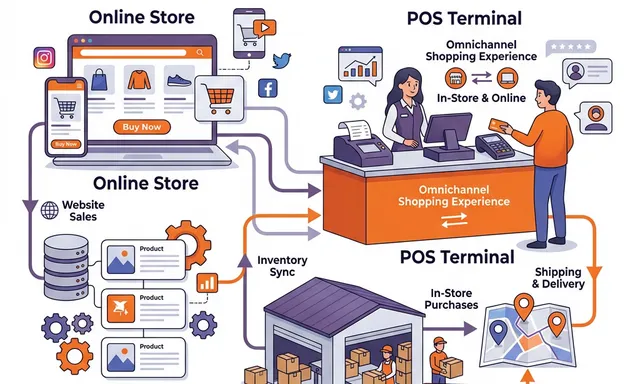
The Omnichannel Imperative
Customers don’t think in channels — they think in experiences. They expect to:
- Browse your website on their phone during lunch
- Reserve a product for in-store pickup the same day
- Get personalized recommendations based on both online and offline purchases
- Return an online order at any physical location
- Receive consistent pricing and promotions across all touchpoints
Yet most retailers operate with disconnected systems that make this impossible:
- Separate POS that doesn’t sync with the website
- Different inventory counts for online and in-store
- No unified customer profile linking online and offline behavior
- Manual price updates across multiple systems
- Siloed promotions that confuse customers
The gap between customer expectations and operational reality is where sales are lost.
What Unified Commerce Means
Unified commerce goes beyond “omnichannel” — which typically means connecting separate systems with integrations. Unified commerce means operating from a single platform where every channel shares the same data in real-time.
Single Source of Truth for Inventory
- Real-time stock visibility across all locations, warehouses, and online channels
- Universal availability — show customers what’s actually available, everywhere
- Order routing — automatically fulfill from the optimal location based on proximity, stock levels, and shipping cost
- Inventory reservation — hold stock for online orders without overselling in-store
Unified Customer Profile
- Single customer record linking online accounts, in-store purchases, and loyalty programs
- Complete purchase history regardless of channel
- Preference tracking — sizing, color preferences, favorite categories
- Communication history — support tickets, email interactions, and in-store consultations
Consistent Product Information
- One product catalog with pricing, descriptions, and images used across all channels
- Real-time price updates that take effect everywhere simultaneously
- Centralized promotion management — create once, apply everywhere
- Product enrichment — detailed descriptions and images for online, simplified views for POS
The Modern Retail Technology Stack
Point of Sale (POS)
Modern POS goes far beyond processing payments:
- Instant product lookup with barcode scanning or search
- Customer identification — pull up loyalty points, purchase history, and preferences
- Flexible payment methods — card, cash, mobile wallet, split payment, gift cards
- Offline mode — continue processing sales even when internet connectivity drops
- Cross-channel returns — accept returns from any channel at any register
- Employee management — track individual performance and commissions
eCommerce Platform
Your online store must be more than a catalog:
- Responsive design that works flawlessly on mobile, tablet, and desktop
- Search and filtering that helps customers find products quickly
- Product recommendations based on browsing and purchase history
- Guest checkout — don’t force account creation for first-time buyers
- Multiple delivery options — ship to home, click and collect, same-day delivery
- Live inventory display — show real-time availability by location
Inventory & Fulfillment
The operational backbone that makes everything possible:
- Real-time synchronization between POS, eCommerce, and warehouse systems
- Order management — view, track, and fulfill orders from any channel
- Ship-from-store — use retail locations as fulfillment centers for online orders
- Returns processing — manage returns and exchanges across channels
- Demand planning — forecast by channel, location, and season
Measuring Retail Performance
| KPI | Description | Benchmark |
|---|---|---|
| Conversion rate (online) | Visitors who purchase | 2–3% (industry avg) |
| Average order value | Revenue per transaction | Trending upward |
| Customer acquisition cost | Marketing spend per new customer | Decreasing over time |
| Customer lifetime value | Total revenue per customer | > 3x acquisition cost |
| Inventory turnover | How quickly stock sells through | 4–6x per year |
| Cross-channel rate | % of customers using 2+ channels | Target: 30%+ |
| Return rate | % of orders returned | < 10% |
Why Odoo for Retail?
Odoo provides a true unified commerce platform:
- POS module with offline capability, barcode scanning, and loyalty programs
- eCommerce builder with responsive design and SEO optimization
- Inventory with multi-location management and automated reordering
- Sales module for B2B orders, quotations, and wholesale management
- CRM for customer relationship tracking across channels
- Accounting with integrated payment processing and financial reporting
Everything shares the same database — no integrations, no synchronization delays, no data conflicts.
Pricing Advantage
Traditional retail technology stacks require licensing fees for POS, eCommerce, inventory, CRM, and accounting separately. With Odoo, everything is included in a single platform — saving retailers 40–60% on technology costs compared to best-of-breed alternatives.
Getting Started
NETLINKS Inc. has helped retail and eCommerce businesses implement unified commerce solutions that increase sales, reduce costs, and deliver the seamless experiences customers demand.
Stay Informed with Expert Insights
Discover the latest trends in ERP, AI, and digital transformation from our certified technology experts.
100+



Resources to boost
your growth